
One molecule, three prices: who keeps the gas spread?
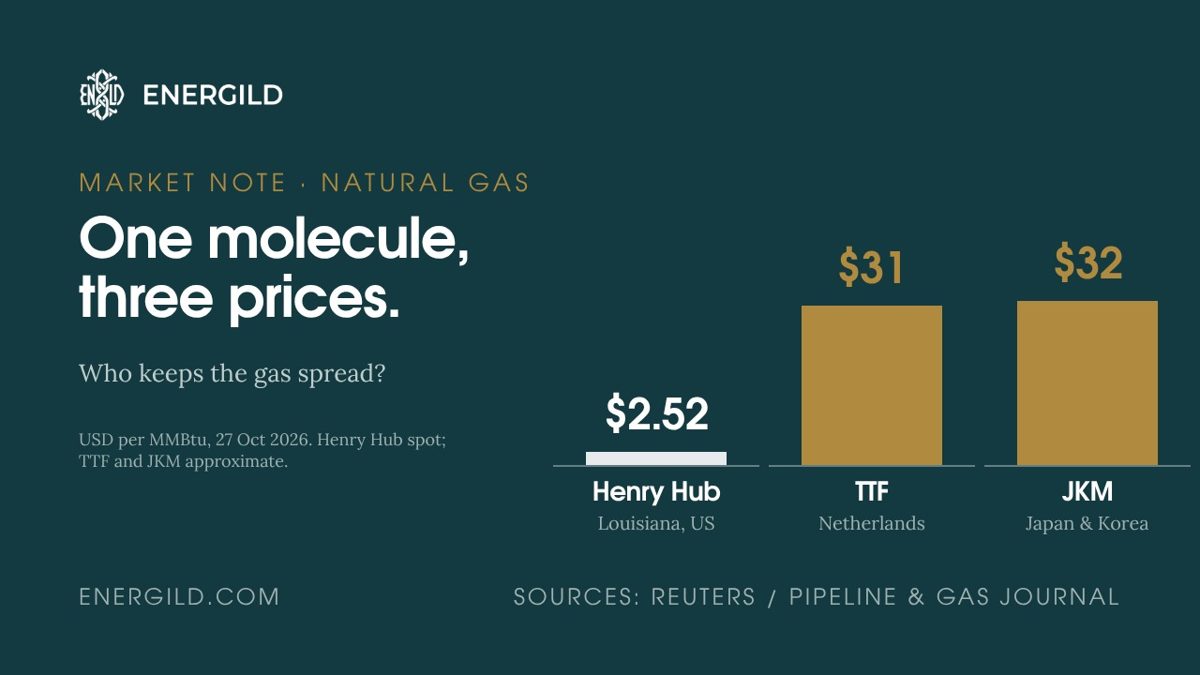
This week, the same unit of natural gas cost about $2.50 in Louisiana and around $31 in the Netherlands. In Japan and Korea, December cargoes were priced near $32.
That's more than ten times the American price for the same molecule. In a normal year, the gap between Henry Hub and Europe's TTF is a few dollars. Today it is close to thirty.
Why the gap doesn't close
In oil, a gap like this would be traded away within weeks: someone buys the cheap barrel, charters a ship and sells the expensive one. Gas doesn't work that way, because a molecule can only cross the ocean as LNG, and every step of that chain has a hard limit.
- Liquefaction. US export plants are running near full capacity. America can't send more LNG abroad until new trains are finished, so cheap US gas stays at home and the domestic price falls.
- Shipping. LNG carriers are specialised and booked long in advance. Spare ships are scarce, and with Hormuz disrupted and the Red Sea under attack, voyages are longer.
- Regasification and storage. Europe can only take in what its terminals can turn back into gas. Asia competes for the same cargoes.
When capacity is the bottleneck, the spread doesn't disappear. It's captured by whoever owns the bottleneck.
Who keeps the difference
Not the producer: a driller in Pennsylvania sells at Henry Hub, the low price. The value goes to those with access to the scarce links: contracted liquefaction capacity, LNG cargoes free to sail to the best market, and available ships.
What it means for Europe
European industry pays the high price. Switching from gas to oil products isn't an easy way out either: EU carbon costs make heavy fuel oil and diesel expensive for power and heat. So the adjustment comes mainly through lower industrial demand, which is the hardest part for economies like Central Europe's.
What it means for oil traders
The same logic now applies in oil. Freight above WS 1,000, Gulf barrels discounted at the loading port and expensive at discharge, jet in Africa trading well above Europe: the value sits with whoever controls the scarce link. Today that's usually the ship, the allocation and the financing, not the barrel itself.
Prices are set at the bottleneck. In a disrupted market, a trader's job is to know where the bottleneck is this month, and to be ready to move when it shifts.
Prices: Henry Hub spot 27 October 2026; TTF and JKM approximate. Source: Reuters via Pipeline & Gas Journal.
← All insights